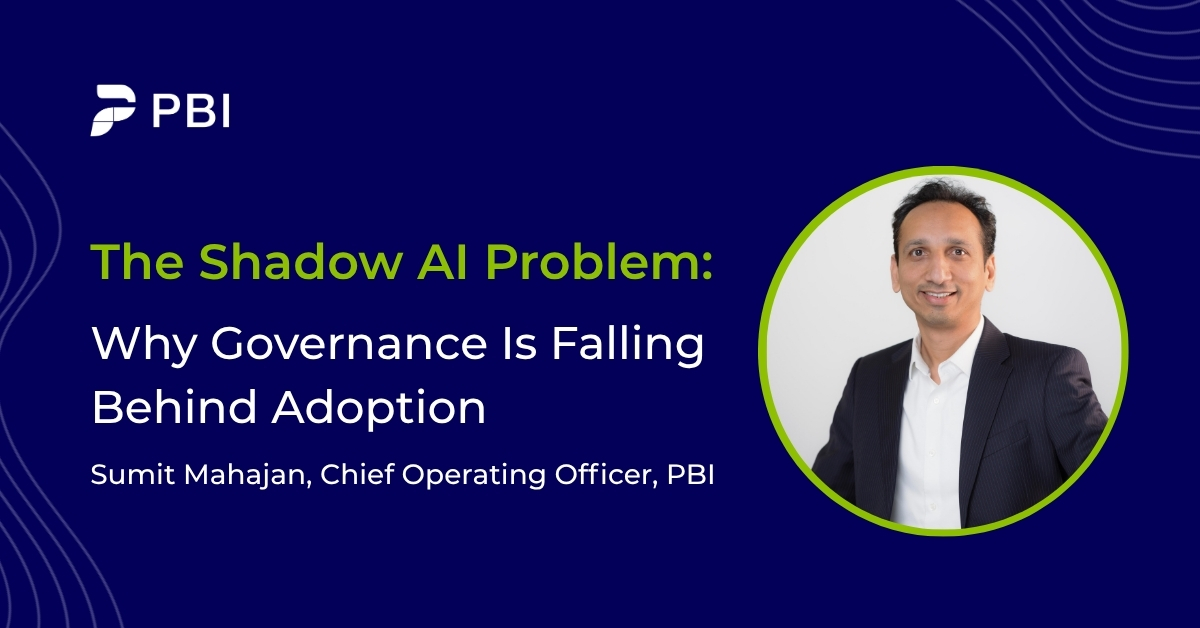
By Sumit Mahajan, Chief Operating Officer
Artificial intelligence is reshaping how work gets done across financial services and alternative investments. Firms are evaluating enterprise AI strategies, productivity is accelerating, and the pressure to adopt is real. The tools are more accessible than ever, and employees at every level are using them.
The problem is not the tools, but the gap between what organizations sanction and what employees actually use. Every day, analysts and business teams are turning to AI outside the control of IT, security, or compliance, feeding sensitive data into consumer platforms with no protection, no audit trail, and no governance. This is Shadow AI, and it already exists inside your organization.
From Shadow IT to Shadow AI
Most organizations are familiar with Shadow IT, which occurs when employees use software, apps, or services without formal approval from their internal IT. Common examples include personal file-sharing accounts, unapproved SaaS applications, or collaboration tools. While these practices are frustrating, they are usually manageable.
Shadow AI presents fundamentally different and more serious risks. When employees use unsanctioned AI tools, they are not just storing files in the wrong place. They may be feeding proprietary data into third party models intentionally or unintentionally with unclear retention policies or generating analysis that influence business decisions without documentation or oversight. When that activity is multiplied across dozens of teams and thousands of interactions per day, the risks compound quickly.
Shadow AI creates several serious exposures:
- Sensitive client, financial, or operational data leaving the enterprise through consumer AI platforms
- Operational risk when AI generated outputs are embedded in business processes without proper validation or oversight
- Compliance gaps as regulators increasingly require transparency around how AI influences decisions
- Inconsistent outputs when teams rely on different tools and models
- Decision risk when AI-generated insights shape strategy without governance or validation
Why Shadow AI Is Emerging
Shadow AI is not primarily a behavioral problem; it is a structural workflow problem. Employees are under pressure to move faster, analyze more information, and produce insights quickly. AI tools help them do exactly that. When organizations fail to provide accessible, sanctioned options, employees find their own.
Several forces are accelerating this trend. The number of AI tools in the market has exploded, entry barriers have dropped dramatically, and powerful tools are available for little or no cost. At the same time, AI capability is evolving faster than traditional procurement and security review cycles. By the time an organization formally approves one tool, several more have already appeared.
The Compliance Visibility Problem
For compliance teams, Shadow AI creates a difficult reality. They are expected to govern the use of AI across the organization, but much of that usage happens outside their visibility. Without clear oversight, organizations cannot confidently answer basic questions about which AI tools employees are using, what data is being shared, or how AI outputs are influencing decisions. In regulated industries, that lack of transparency becomes a material risk.
The Path Forward
Organizations that respond with restriction rather than governance do not solve the problem; they lose visibility into it. Instead, firms need to provide a sanctioned AI environment that meets employees where they work. That means offering tools with appropriate data protections, clear usage policies, and enough capability to compete with the consumer tools employees are already using.
PBI Insights provides investment and operations teams with a natural language interface to query portfolio data, generate analysis, and surface actionable intelligence. Available as a Teams application with integrations to popular models such as Claude and ChatGPT, solutions like these provide the functionality employees need while ensuring data remains secure and auditable. The result is less reliance on unapproved alternatives and more control for firms.
AI adoption will only accelerate from here. The real question facing leadership teams is not whether Shadow AI exists inside their organization, but whether they are willing to acknowledge it and put governance in place before the risks compound further.